Africa Embrace Zero-Tariff Policy: Implications for the Chinese Market
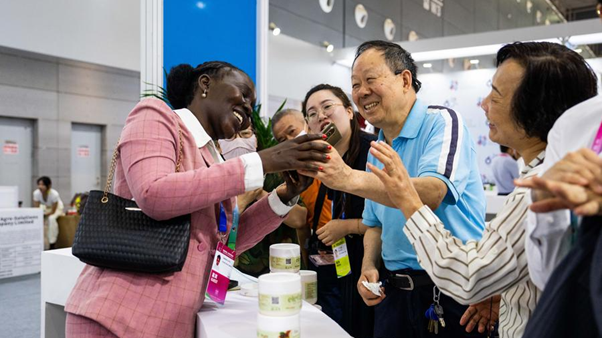
An exhibitor (L) chats with visitors during the fourth China-Africa Economic and Trade Expo at Changsha International Convention and Exhibition Center in Changsha, central China's Hunan Province, June 13, 2025. /Xinhua
Starting May 1, 2026 China will eliminate tariffs on all products imported from 53 African countries with which it maintains diplomatic relations. The sweeping tariff exemption seeks to remove market-access barriers, as China moves to further open its domestic market to the African continent and deepen economic ties. For China and Africa, both key partners within the Global South, trade is vital to economic, social and industrial development. Last year trade between China and Africa hit another milestone amid rising global trade protectionism. Data from China’s General Administration of Customs show China-Africa trade volume surged to a record $348 billion, up 17.7 percent year on year. Of this total, China’s imports from Africa reached $123 billion, a 5.4 percent annual expansion. For China, Africa’s largest trading partner over the last 17 consecutive years, imports from the continent including minerals and agricultural products are essential inputs for its manufacturing value chains and support food security.
Home to abundant natural resources including 65 percent of the world’s arable land, 30 percent of the world’s mineral reserves, 12 percent of the world’s oil reserves and a population of more than 1.5 billion people, Africa is a major source of strategic resources and a key export market for China. By expanding the zero-tariff policy to include 53 African countries, a significant milestone in South-South trade, which aligns with trade-friendly policies enshrined in the African Union’s Agenda 2063 and the 2030 Agenda, the initiative has the potential to further unlock new growth opportunities in the Chinese market. First proposed at the Forum on China-Africa Cooperation (FOCAC) Ministerial Conference in 2003 and implemented in 2005 for a select group of products, the zero-tariff policy has since been progressively expanded. On Dec.1, 2024 China expanded the initiative to include 33 African least developed countries (LDCs) and by March 2025, Chinese imports from African LDCs had grown by 15.2 percent to $21.42 billion according to data from China’s Ministry of Commerce. For example, last year Uganda, one of the African LDCs and the continent’s leading coffee exporter witnessed exports to China surge 73.8 percent year-on-year to $138 million – coffee accounts for the largest share at $62 million, marking a 99.3 percent expansion.
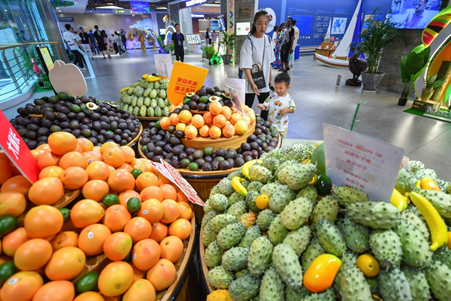
A woman and her child shop for African fruits at the China-Africa Economic and Trade Cooperation Promotion Innovation Demonstration Park in Changsha, central China's Hunan Province, July 1, 2023. /Xinhua
For these low-income African countries, which are highly susceptible to economic and environmental shocks, tariff-free market access to a stable and predictable demand from the Chinese market offers the opportunity to accelerate economic diversification, unlock value addition potential, modernize agriculture and foster industrialization. As China shifts towards consumption-led and technology-driven expansion to sustain high-quality growth that is inclusive, green and balanced, the attempt to institutionalize tariff-free market access for all African imports could be a central part of the country’s economic strategy. From now and into the future, China, guided by the 15th Five-Year Plan (2026-2030) identifies the transition to consumption-led growth and the development of ‘‘new quality productive forces’’ as the overarching policy priority. With this policy focus, the zero-tariff policy complemented by various initiatives such as the ‘‘green channel’’ has the potential to increase the availability, variety and affordability of African goods on the Chinese market – and ultimately help stimulate consumption levels, raise productivity and support higher standard of living.
The expanded non-reciprocal tariff exemption, implemented alongside key initiatives such as the ‘‘green channel’’ could help trigger the structural transformation Africa needs in its value addition and agriculture sector where much of the potential remains untapped. For China, a rapidly growing African market offers long-term trade partnerships, attracts investment and serves as a destination for strategic resources. For example, this month Zimbabwe, Africa’s top lithium producer became the first country on the continent to export locally processed lithium sulphate, thanks to Chinese firm Zhejiang Huayou Cobalt. In 2025 trade between China and Zimbabwe expanded by 14.7 percent year-on-year. Zimbabwe ended the year with $720 million trade surplus with China. While China’s imports reached $2.56 billion with tobacco (hitting a record $790 million), its largest import accounting for 31 percent of the total, Zimbabwe also exported 5,200 metric tons of macadamia nuts value at $11.62 million – reflecting a growing demand for high-value African agricultural products on the Chinese market.
Under the FOCAC framework, China in November 2021 announced the ‘‘green channel’’ to facilitate imports of African agricultural products, and by June 2023 the initiative had supported 16 agricultural products from 11 African countries to enter the Chinese market. Benefitting from the ‘‘green channel’’ initiative, which has helped streamline inspection and quarantine processes, in recent years China’s consumer market has witnessed a growing number and wider range of African agricultural goods. By 2024 China’s imports of agricultural products from the continent had grown to $5.3 billion, compared to $190 million in 2000, becoming Africa’s second-largest market for agricultural goods. As China embarks on a unilateral opening up to ensure full market access to African imports, the move identified as a significant milestone in South-South cooperation, cements the Asian country’s position as the primary economic anchor for the Global South. Supported by initiatives such as the ‘‘green channel,’’ Belt and Road Initiative, African Continental Free Trade Area and a host of international trade exhibition events including the China-Africa Economic and Trade Expo, which brings together participants from the two sides, the expanded zero-tariff policy could further integrate African value chains into the Chinese market, and unlock new growth opportunities for both parties and beyond.
About the author: Alexander Ayertey Odonkor is the founder and leading expert at the Ghana Centre for China Studies, Africa’s preeminent and most comprehensive platform exclusively dedicated to authoritative interpretation of China’s domestic and foreign policies.
Production credits: This commentary is produced by the Ghana Centre for China Studies, and published in a joint collaboration with the CGTN.
At the Ghana Centre for China Studies we eschew specific policy positions. All positions and opinions expressed in this publication are solely those of the author (s).