Navigating the India-China Equation through the Invisible Borders of Quantum, Water, Trade and the New Architecture
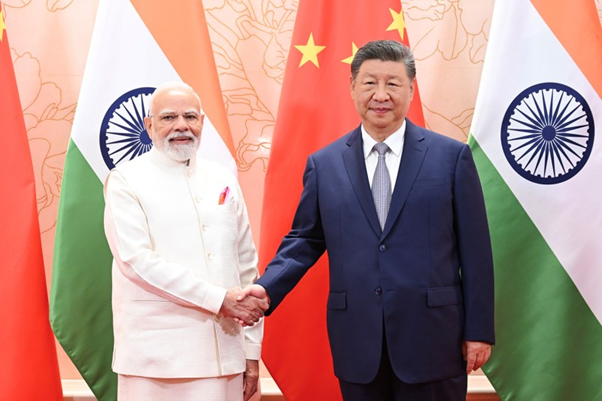
Chinese President Xi Jinping meets with Indian Prime Minister Narendra Modi in Tianjin, China, on Aug. 31. XIE HUANCHI/XINHUA VIA GETTY IMAGES
As the year 2026 unfolds, India-China relations are no longer merely described by a simple “border dispute with a trade issue.” Standing at the intersection of policy and theory, it can be said that the old tussle on the map has now become secondary, as the true ‘topography’ of the India-China conflict stands on the digital, hydrological, and orbital platforms. With the scholarly consensus shifting towards the discussion of ‘Systematic Friction’, as terminologies and policies like ‘The Wuhan Spirit’ and ‘The Chennai connect’ are turning into archived words, the relations have evolved into a full-spectrum systematic competition, turning into a contest between two very different visions of modernity, governance, and technology for the 21st century. As India prepares to host the 18th BRICS Summit in New Delhi, we might just be testing resolve with an “Asymmetric Peer”.
China’s relentless push towards having ‘Quantum Superiority,’ the ability to break modern encryption, has turned the digital infrastructure of both India and China into a fresh new front line. If China achieves the ability to break RSA encryption, India’s strategic autonomy might stand at risk of turning into a myth. However, as China seeks a ‘backdoor’ into global institutions and networks, India, under the National Quantum Mission, moves from the banning of apps to ‘architectural immunity’ championing the new Silicon LAC, what can be called “Sovereign Tech”, as a nation’s sovereignty is only as strong as its encryption.
Here is another area of interest; the trade deficit with China continues to remain a structural hurdle, which nearly hit around $118 billion in 2025. In early 2026, China escalated its dispute at the WTO against India’s Production Linked Incentive (PLI) schemes, particularly in the EV and battery sectors, moving the WTO against India’s ‘Green Manufacturing’ subsidies, claiming that India’s EV battery PLIs are discriminatory. The reality is that India remains reliant on Chinese active pharmaceutical ingredients (APIs) and the solar components to power its growth; however, India’s trade policies have shifted towards assurance and agility. Building domestic giant factories and securing Critical Mineral Pacts with the QUAD and mineral–rich Global South nations, India is on the path to systematically reducing the leverage that China can exert over its green transition and bypassing the Chinese supply chain entirely.
In 2026, the Global South has turned into the primary stage for a silent yet profound struggle between the two digital philosophies: the Indian “Digital Public Infrastructure”, a model for Code and empowerment, and the Chinese “One Belt One Road Initiative” (Digital Silk Road), a model of Steel and Debt. While China pushes its focus on building the hardware and 5G ‘pipes’, India turns towards exporting the software and protocols of modern governance. The core differentiator for this year turns out to be Digital Sovereignty, as African and Southeast Asian nations have grown wary of the “vendor lock-in” trap associated with Chinese hardware from its dominating tech companies, through which a slight change in diplomatic relations could lead to a digital shutdown. India’s DPI, such as Aadhaar ID, UPI Payment, and Digilocker Data applications, are built on open-source standards, which allows nations like Kenya, Ethiopia, etc. which adopted India’s DPI framework very recently, to build their own local versions.
Through this framework, nations own the data and the code, ensuring they are the prime owners of their own national stack and not just users of an Indian framework. On the other hand, China’s Digital Silk Road is a State-driven initiative, a top-down architectural philosophy where host nations have to rely on Chinese firms for maintenance and upgrades. China’s Digital Silk Road has traditionally been a hard-tech play, bundled with massive infrastructure loans, due to which the major talking point of the global south now turns towards the sustainability of these projects. Taking a lead, the Indian UPI (Unified Payments Interface) is live in over eight countries, including the UAE, Singapore, France, and Qatar, with a major push into the African market. Adopting a UPI- style payment system reduces the cost of cross-border remittances by up to 80%, tangibly improving the conditions of migrant workers, which contributes to a silent yet powerful construction of a “soft power”.
With the Brahmaputra River (Yarlung Tsangpo) transitioning into a major kinetic variable, China’s mega dam in Medog (to generate 60000 MW), near the sensitive ‘Great Bend’ has reached a critical construction phase this year, forcing India into a defensive posture that is both engineering-heavy and diplomatically sharp. China uses its “upper riparian” status as a tool of Hydrological Coercion, possessing the ability to control slit flow of water and seasonal water volume, which can be used to create “artificial floods” during monsoons. China’s massive turbines are a physical manifestation of their so-called ability to control the pulse of North East India, as China frames it as “Green Energy”, the lack of transparency in data sharing treaty creates a “black-box” scenario for the Indian downstream. India counters this challenge through its very own strategic buffer construction that could be termed as a “Hydraulic Deterrent”, a 11000 MW Upper Siang Project in the state of Arunachal Pradesh, designed to act as a buffer, absorbing sudden surges and ensuring that the downstream states can retain their right to life and water. India moves towards a “Data as Deterrence”, insisting on real-time automated hydrological data sharing, which is now a non-negotiable prerequisite for any such “thaw” in bilateral ties.
With the tactical de-escalation at the border and the resumption of high-level dialogues in New Delhi and Tianjin, the immediate risk of kinetic conflict has been reduced. However, these diplomatic successes have not erased the deep-rooted structural oppositions that could define this decade. The competition between the two has moved from the heights of the Himalayas to the architecture of global trade and technology. Ultimately, the trajectory for this year suggests that both India and China are learning to decouple their economic and security interests, increasingly treating their relations as a long-term strategic marathon where success is measured through strategic resilience rather than a sprint to total resolution.
About the author:
Anugya Bharadwaj (班慧梅) is a Research Analyst at the Ghana Centre for China Studies. Currently pursuing her Master’s Degree in Chinese Language and China Studies at the Department of East Asian Studies, University of Delhi, Anugya Bharadwaj holds a Bachelor of Arts in Chinese Studies, First Class Honours, from Visva Bharati. Read More
Production credits: This commentary is produced by the Ghana Centre for China Studies, Africa’s preeminent and most comprehensive platform exclusively dedicated to authoritative interpretation of China’s domestic and foreign policies.
At the Ghana Centre for China Studies we eschew specific policy positions. All positions and opinions expressed in this publication are solely those of the author (s).