The Mandate of Rejuvenation: Neo-Traditionalism, Mythological Synthesis, and Political Legitimacy under Xi Jinping
_
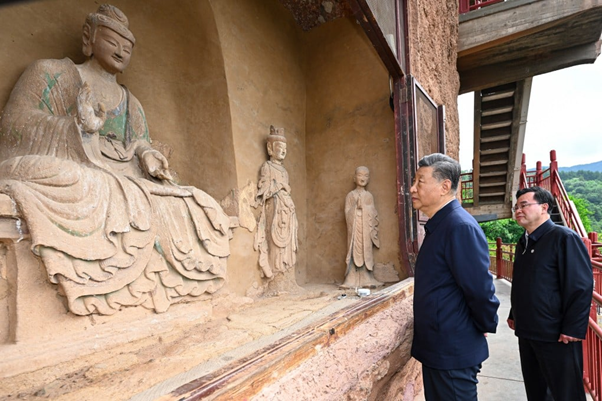
For much of the 20th century, the CCP’s relationship with China’s past was defined by revolutionary iconoclasm, most notably during the Cultural Revolution, which sought to dismantle the "Four Olds." However, under the Chinese President Xi Jinping, the state has undergone a "civilizational turn." In the current era of Xi, the Communist Party of China (CCP) has instead adopted a strategy labelled by various scholars as “Sinicization” and “Ethno-symbolic legitimacy”. The Party no longer presents itself merely as a Marxist vanguard but as the final, neccessary culmination of Chinese history, positioning itself as the sole guardian of an ancient civilisation. This transition marks a shift from teleological Marxism (aiming for a future utopia) to ethno-symbolic nationalism (anchoring legitimacy in an idealized past).
The fundamental piece of the current statecraft puzzle is the Chinese Dream of the Great Rejuvenation of the Chinese Nation, which unlike the abstract proletarian internationalism of the past, is a deeply rooted nationalist myth. Various prominent scholars argue that Xi’s “Chinese Dream” (中国梦) functions as a sacred narrative that replaces the fading appeal of communist utopia with the "Great Rejuvenation of the Chinese Nation”. By framing the current era as a "rejuvenation," the state implies that China is returning to a "natural" state of global pre-eminence that was only temporarily interrupted by the "Century of Humiliation” (1839-1949). Using the historical incidents, the Party’s rule is presented not as a political choice but as a historical necessity. In the mythological framework of the ‘5000 years of uninterrupted history’, it suggests that the Party is the modern successor to the great dynasties, inheriting a "Mandate" to restore China to its rightful place at the centre of the global order and is the only entity capable of bridging the gap between the greatness of the Han and Tang Dynasties and the complexities of the 21st century.
Xi has also integrated traditional philosophy into Xi Jinping Thought, moving toward a "State Confucianism" that emphasizes hierarchy and stability. Scholarship often highlights the "Confucianization" of the CCP, but the reality is a synthesis of Confucianism (儒教) (for public morality) and Legalism (法家) for state administration. The state promotes Xiao (孝-filial piety) and He (和-harmony) to foster a culture of political obedience. By positioning the Leader as a paternal figure, a modern "Son of Heaven" in function if not in name, dissent is framed not just as political opposition, but as a violation of the "natural" social order. Underneath the rhetoric of "governing the country with virtue" lies the Legalist emphasis on "governing the country according to law" (依法治国). Here, law is not a check on power but a tool of statecraft, used to ensure absolute compliance through technology-enabled surveillance.
Although the CCP remains officially atheist, it positions itself as the "protector" of "healthy" (state-sanctioned) Buddhism and Daoism. By doing so, it co-opts these religions to promote "cultural confidence" (自信) while suppressing "foreign" influences like Christianity and Islam, which are framed as threats to national security. Also, the use of mythology extends beyond domestic borders through the revival of Tianxia- 天下 (All-Under-Heaven). Historically, this concept described a world order centred on the Chinese Emperor’s moral and political authority. Xi’s foreign policy rhetoric echoes Tianxia by proposing a new global governance model that ostensibly moves beyond the Westphalian system of competing nation-states. By utilizing this ancient trope, China positions its rise not as a threat to the global order, but as the restoration of a more "harmonious" and "natural" hierarchy with China at the centre.
The strategic pivot under Xi Jinping toward a neo-traditionalist legitimization strategy represents a profound departure from the revolutionary teleology of the 20th century. By synthesizing Marxist-Leninist organizational discipline with the symbolic authority of ancient cosmological myths, the CCP has moved to insulate itself from the volatility of "performance-based legitimacy." In this framework, the Party is no longer merely an economic manager subject to the whims of GDP growth; it is the metaphysical guardian of the Chinese civilization-state.
However, this transition introduces a critical paradox that may define the coming decades of Chinese governance:
By invoking the language of "Rejuvenation" and civilizational continuity, the state inadvertently reactivates the historical logic of the Mandate of Heaven (天命). Historically, the Mandate was never an unconditional right; it was a moral contract contingent upon the ruler's ability to maintain "Great Harmony" (大同). By positioning himself as the central "core" (核心) equivalent to a modern Sage-King, the leader assumes total responsibility for both the successes and the calamities of the nation. In a mythological framework, systemic failures, be they environmental disasters, economic stagnation, or social unrest, are often interpreted not as policy errors, but as signs of a "lost mandate."
Furthermore, the "Sinicization" of religion and the usage of mythology create a rigid ideological landscape. When political policy is framed as a sacred historical mission, the room for pragmatic retreat diminishes. The "Chinese Dream" becomes a non-negotiable teleology; any deviation from the path of national rejuvenation is framed as an existential betrayal of the ancestors. This limits the CCP’s flexibility in international diplomacy, as concessions to foreign powers can be cast as a return to the "Century of Humiliation," thereby undermining the very myth the state has spent decades constructing.
Finally, the attempt to reconcile a Digital Leviathan (driven by AI, big data, and Legalist social control) with a Confucian Moral Order creates deep psychological friction within the citizenry. The state demands filial devotion and traditional virtue while simultaneously imposing a hyper-modern system of surveillance that often erodes the organic trust found in traditional communities.
In conclusion, while the use of mythology and religion has successfully provided the CCP with a "cultural shield" against Western liberal universalism, it has also tethered the Party’s future to the hazardous cycles of dynastic history. The administration has successfully claimed the mantle of the past to secure the present, but in doing so, it has invited the ancient traces of the "dynastic cycle" to haunt its future. The survival of the regime now depends on its ability to prove that its "Modernity with Chinese Characteristics-中国特色现代化" can achieve what no previous dynasty could: a permanent, unchanging mandate.
About the author:
Anugya Bharadwaj (班慧梅) is a Research Analyst at the Ghana Centre for China Studies. Currently pursuing her Master’s Degree in Chinese Language and China Studies at the Department of East Asian Studies, University of Delhi, Anugya Bharadwaj holds a Bachelor of Arts in Chinese Studies, First Class Honours, from Visva Bharati. Read More
Production credits: This commentary is produced by the Ghana Centre for China Studies, Africa’s preeminent and most comprehensive platform exclusively dedicated to authoritative interpretation of China’s domestic and foreign policies.
At the Ghana Centre for China Studies we eschew specific policy positions. All positions and opinions expressed in this publication are solely those of the author (s).