The Asantehene Model: Cultural Diplomacy for African Development
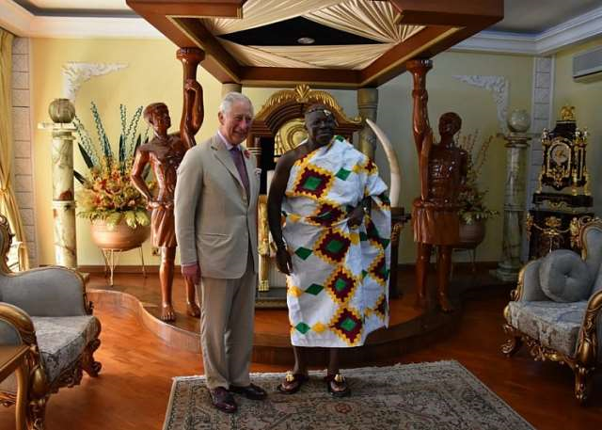
His Royal Majesty Otumfuo Osei Tutu II and His Royal Majesty King Charles III (then Prince of Wales) at Manhyia Palace, Kumasi. Photo Credit: Manhyia Palace
On August 30, 2026 the Bowie State University, Maryland’s oldest historically black institution of higher education witnessed first-hand the Akwasidae Festival, a sacred event observed every six weeks on the Asante traditional calendar. Typically celebrated at the Manhyia Palace, the seat of the Asantehene, His Royal Majesty Otumfuo Osei Tutu II, to honour ancestors and reaffirm the unity and heritage of the Asante Kingdom, the sixth Akwasidae Festival this year, was held in the United States. The historic event, presided over by the Asantehene, brought together a host of African diaspora, and notable voices in government, academia and business. Present at the grand festival marked by a unique display of the Asante regalia, drumming and dancing were the Governor of Maryland Wes Moore, Prince George’s County executive Aisha N. Braveboy and Bowie State University President Aminta H. Breaux along with other dignitaries.
Prior to the Akwasidae Festival, which served as the grand finale of the Millennium Excellence Week America 2026, the Asante King, during his 10-day working visit to the United States, also delivered a historic Royal Guest Lecture at Howard University. During the opening remarks of Anthony K.Wutoh, Ph.D.,R.Ph., Howard University’s provost and chief academic officer, he said: “Your Majesty, your presence on this historic campus is profoundly meaningful,” Wutoh, who has Ghanaian roots, added that: “As one of Africa’s most respected traditional leaders, you’ve distinguished yourself through visionary leadership, steadfast dedication to education, impactful philanthropy, and an unwavering commitment to the advancement of your people and the African continent. Your leadership reflects the values that resonate deeply with Howard University’s mission of truth, service, excellence and global engagement.” At the event which marked the first time Howard University, one of America’s top Historically Black research institutions had hosted a sitting African King, His Royal Majesty Otumfuo Osei Tutu II, expounded on the preservation of cultural heritage, the enduring strength of the African diaspora and the unity of African people across the globe. “Let us strengthen the bonds between Ghana and the global African diaspora, not merely through ceremonies and declarations, but through scholarship, education, investment, cultural preservation, service, enterprise, healing and enduring human relationships,” the Asantehene said.
In Ghana, and across the entire African continent, for decades, the most significant and measurable diaspora contribution has been remittances. For millions of people on the African continent, diaspora remittances are an essential economic lifeline, supporting families to cover daily expenses. In West Africa, for example, the region in 2023 alone received more than US$32 billion in personal remittances – six times the region’s inflow of official Development Assistance (ODA) and more than double its Foreign Direct Investment (FDI). For Ghana, home to sub-Saharan Africa’s second-largest remittances recipient, these funds account for 6 percent of the country’s GDP, amounting to US$4.6 billion in 2024 – reaching a historic high of nearly US$7.8 billion in 2025, according to the Bank of Ghana. To put this into perspective, diaspora remittances surpassed the combined inflow of ODA and FDI to Ghana over the period. However, despite its scale and stability the Bank of Ghana points out that these funds tend to support immediate household consumption rather than productive long-term investments.
As part of efforts to tackle this macro-trend in Africa, His Royal Majesty Otumfuo Osei Tutu II, has challenged the diaspora to focus on long-term investments. In a recent engagement with the diaspora in Toronto at the 'Beyond the 2026 World Cup’ Power Breakfast Business Meeting', organized by the Canada Ghana Chamber of Commerce, Otumfuo urged Ghanaians in the diaspora to “move from emotional attachment to strategic engagements, saying “remittances are important, but they are not enough. We need diaspora investment funds, mentorship networks, professional exchanges, technology transfer, export partnerships, and partnerships in structured business platforms.
“Let a Ghanaian professional in Toronto mentor a Ghanaian entrepreneur in Kumasi. Let the Ghanaian engineer in Calgary partner with a technical institute in Ghana. Let a Ghanaian wealthy professional in Ontario support healthcare at home, let the Ghanaian investor in Canada consider agribusiness, housing and education.”
For years, policymakers and relevant stakeholders in Ghana and across the entire African continent have grappled with attempts to shift billions in diaspora remittances from a social safety net into structured, long-term productive investments. According to the United Nations Economic Commission for Africa (ECA), in 2025 diaspora remittances inflow to the continent surpassed US$100 billion and supported more than 200 million relatives, primarily in rural communities. In some African countries, these funds helped reduce poverty by up to 40 percent. Beyond remittances, the African diaspora is a critical source for technology transfer, skills and knowledge acquisition essential for sustainable development. However, unlocking the full potential of these transformative capacities to support sustainable development which remains a daunting challenge requires adequate frameworks and policies that promote diaspora contributions. Key to this effort, however, is cultural diplomacy, a critical bridge that facilitates cultural connection, and ultimately establishes trust and identity; the foundation for diaspora long-term economic investments in Africa.
For Ghana and the African continent, the Asante King stands out in leveraging cultural diplomacy for development. For nearly three decades, the 16th Asante King, His Royal Majesty Otumfuo Osei Tutu II has strived in connecting the Asante Kingdom to the rest of the world. Over the period, Otumfuo has leveraged cultural diplomacy to solidify and maintain long-standing ties with foreign royalties, governments and international organizations, across Europe, Asia, Africa, North America and beyond. For example, during Ghana’s previous administration led by the former President Nana Addo Dankwa Akufo-Addo, the education Minister at that time Dr. Matthew Opoku Prempeh disclosed that the timely intervention of His Royal Majesty Otumfuo Osei Tutu II compelled the World Bank Group to reverse its decision to cancel two major educational projects in the country. Thanks to Otumfuo’s intervention, the World Bank Group rescinded its decision, releasing US$400 million for the two projects; the Ghana Accountability for Learning Outcomes Project (GALOP), an initiative targeting the country’s 10,000 lowest performing basic schools and the Jobs and Skills Project, which seeks to support skills development and job creation. Additionally, Ghana’s former President John Agyekum Kufour and the current President John Dramani Mahama have both disclosed how timely interventions from the Asantehene helped Ghana secure US$4 billion debt relief under the World Bank Group and IMF HIPC initiative and US$918 million IMF credit facility in 2015.
Beyond the Bretton Woods Institutions, the Asantehene who also maintains decades-long relations with the British Monarchy, marked by high-profile visits and mutual respect, has led broader cultural cooperation with the United Kingdom, including the historic return of Asante gold and silver artefacts to the Manhyia Palace, which were looted more than 150 years ago. The returned Asante artefacts, secured on long-term loan agreements have opened up conversations for other museums around the world to seek redress on how to handle looted items. While this global action is certainly a step in the right direction, for the Asante King preserving cultural heritage is not limited to physical artefacts. Last year, at a ceremony held at the Manhyia Palace to commemorate the 25th anniversary of the Otumfuo Osei Tutu II Foundation, the Asante King said, “Our ancestors fought gallantly and secured this land through the might of arms. Today, we live in a different era. It is not the strength of the gun that determines a person’s future, but the strength of their minds, health, environment, and unity of identity and purpose.”
He added, “I understood that if we were to preserve the heritage they bequeathed to us and prepare our children for the future, we would have to wage a different kind of battle: a battle against ignorance, disease, poverty, and disconnection from our cultural soul.” For more than two and a half decades, the Asante King through the Otumfuo Osei Tutu II Foundation has championed measurable improvements in education, health, community infrastructure and cultural preservation across Ghana. In the field of education, the foundation with support from the World Bank has built and renovated more than 740 school structures and provided full scholarships to thousands of students across Ghana. Additionally, the foundation has donated over 980,000 desks with more than 1,000 school children receiving essential supplies including text books and computers. Again, as the Chancellor of the Kwame Nkrumah University of Science and Technology, ranked 1st in the world by the Times Higher Education (2023) Impact ranking for quality education (SDG 4), His Royal Majesty Otumfuo Osei Tutu II has been pivotal in positioning the university as a competitive hub for science and technology, leveraging cultural diplomacy for academic excellence. In a recent example, the Asantehene, during his 10-day working visit in the United State, facilitated a partnership arrangement between Virginia State University and Kwame Nkrumah University of Science and Technology. Prior to this effort, the Asantehene in 2023 had secured a scholarship package for Ghanaian students to study at the University of Memphis, harnessing cultural diplomacy to drive global research reach and academic excellence, a commendable effort, worth emulating across the entire African continent.
In conclusion, as Ghana and countries across the continent push for sustainable growth and prosperity, across industry and society, it is imperative for policymakers and relevant stakeholders to draw vital lessons from the Asantehene model, which leverages cultural diplomacy for sustainable development. This directive, however, will require strengthened cooperation with traditional leaders and all relevant stakeholders, in a problem-solving process, acknowledging that every party plays an indispensable role in achieving development goals.